
Techno-Optimism vs. Technofeudalism
And the global shared religion of our time.

Complexity and uncertainty are part of reality. Yet our minds crave control. We think we are steering life until the illusion breaks and fear and anxiety emerge. To heal them, we must learn to embrace uncertainty and accept complexity.
It sounds simple, but it’s radical in a world that moves faster than the digestion of food, of thought, of meaning.
Those are wise words that found a place in me from a wise man. Life has granted me some rare encounters, and one of the most transformative was meeting Satish Kumar, one of the few remaining disciples of Mahatma Gandhi. I had the privilege of spending days with him in deep retreat. Fifteen of us gathered around his quiet wisdom a few years ago. His presence was a reminder that progress without purpose is hollow, and that technology without humanity becomes tyranny.
“Speed and utility have become more important than beauty”, he said. We conflate acceleration with progress. But what if technology could help us slow down? Not by restraining us, but by re-orienting us toward what truly matters?
Technology could be, as Satish Kumar would say, Beautiful, Useful, and Durable (BUD).
That is the kind of technology we should strive for: one that minimizes waste and pollution, and maximizes shared satisfaction. One that elevates our collective well-being, rather than extracting it.
I can’t think of a more fitting spirit to open this next Dialectic Dispatch, which I’ve been reflecting on over the past weeks as I regathered notes around this topic.
After deep-diving in the last three essays into one of technology’s most recent manifestations, Artificial Intelligence, I now come back to thirty thousand feet for a broader view: a reflection on how we think about technology itself, between the unbridled faith of the techno-optimists and the sharp warnings of technofeudalism.
Every age builds its own religion. Ours worships technology.
Marc Andreessen’s Techno-Optimist Manifesto reads like a new gospel for the digital century: “Techno-Optimists believe that societies, like sharks, grow or die. Technology is the glory of human ambition and achievement. We believe growth is progress. We believe everything good is downstream of growth.”. It calls us to reject pessimism, to double down on growth, to produce, not complain. It’s a rallying cry for creation, for progress, for courage in the face of stagnation. In some ways, I agree. Technology is one of the most powerful tools humanity has ever invented, enabling us to expand our reach, democratize knowledge, and alleviate scarcity.
But as history teaches us, progress is never neutral. The same engines that build civilizations can also deepen divides. Every wave of innovation has created both abundance and inequality, from the steam engine to the silicon chip. And as we stand on the threshold of the AI era, we must ask: what if the problem is no longer just who controls the means of production, but who owns the means of behavior modification?
Andreessen dismisses the fear that technology will take jobs as a “lie.” Yet even a brief glance at today’s economic landscape — where algorithms might displace cognitive labor at unprecedented speed — reveals that this “lie” conceals a complex truth. Technological revolutions of the past created wealth by broadening access to goods; this one risks concentrating it by automating both capital and cognition. The factory worker of the 19th century could, at least in theory, afford the goods he produced. The white-collar worker of the 21st century may not afford the subscription to the software that replaced him.
In invoking Paul Collier’s line — “Lack of growth is a kill-all” — Andreessen touches something essential. Growth matters. But the irony is striking. The manifesto quotes Collier as an emblem of market-driven dynamism, while ignoring the moral architecture that underpins his entire thesis.
As Collier himself reminds us, growth without fairness corrodes societies from within. Collier has long argued that growth without inclusion corrodes the very social fabric that sustains it. In his book The Future of Capitalism, he calls for a more present and ethical State. One that fosters communitarian thinking, coordinated taxation, and corporate boards that balance commercial and public interests. He defends a moral capitalism that prioritizes dignity over profit, and warns that when societies leave too many behind, resentment becomes the most powerful political currency. Any parallels to what we are seeing today?
Silicon Valley’s loudest champions of abundance often turn quiet when the conversation shifts to redistribution. They preach progress, but oppose affordable housing near their own backyards. It’s the paradox of the “NIMBY Techno-Optimist”: build the future, but only if it doesn’t disturb the view.
Even the claim in the Manifesto that we need more technology because the global population may already be in decline deserves scrutiny. True, fertility rates are falling in developed nations, but humanity is still growing toward ten billion souls, largely in regions like Africa. One wonders whether the insistence on “productivity over people” disguises an unwillingness to imagine inclusive growth.
Where Andreessen sees markets as pure meritocracies of innovation, the reality is murkier. In theory, markets reward efficiency and, to some extent, creativity; in practice, they are shaped by power. Lobbyists, tax shelters, and “policy entrepreneurship” have bent the invisible hand into a very visible fist. From the Koch family’s decades-long crusade against environmental regulation to Wall Street and Silicon Valley’s push for deregulation, free markets have too often meant freedom for some and precarity for most.
So yes, technology remains one of our greatest levers for possibility. But we must ask: how honest is this techno-optimism? When the manifesto celebrates competition and criticizes monopolies, does it really mean it? Or is it a convenient narrative masking the very concentration of power it claims to oppose?
Behind the rhetoric of “empowering innovation” often lies a coordinated effort to shape regulation in favor of the few…to secure data dominance, favorable tax structures, and exemptions that entrench their market position. It is a striking paradox: those preaching the gospel of open markets are often the same architects of new digital monopolies.
Not all investors follow this creed, of course. Many, at the same level of influence, are advocating the opposite: fairer markets, ethical technology, and distributed prosperity. But what we see in the Techno-Optimist Manifesto is a kind of moral hubris, the same “money-lust” I explored in earlier essays; the belief that wealth creation alone justifies itself, and that those accumulating it are by definition building the future.
It’s not innovation itself that’s at risk, but the intention behind it. When progress becomes indistinguishable from self-interest, technology ceases to be a tool of emancipation and begins to resemble a theology of control.
As Keynes once wrote:
“When the accumulation of wealth is no longer of high social importance, there will be great changes in the code of morals.”
We are overdue for that change.
Between the gospel of the optimists and the warning of the critics lies the real question for our generation:
Can we reclaim technology as a collective project of emancipation, rather than the latest theology of control?
To answer that question, we need first to understand where we are headed. And to understand that, it is worth a quick recap of history, in particular, of medieval times, one of my passions.
In feudalism, land was wealth, and power stemmed from ownership of it. Kings granted vast territories to nobles and knights, who in turn allowed common people, like peasants, to live and work on their estates. The peasants could cultivate the land, even use their lord’s tools, but in exchange they owed a rent in kind: a share of their harvest, their labor, their very time. Protection and access were the privileges of obedience.
It was an economy built not on markets, but on obligation and dependence. The few owned the assets; the many sustained them through continuous tribute.
Today, the currency and the castles have changed, but the logic feels eerily familiar.
In the new order, data has replaced land as the ultimate source of wealth. The new feudal lords are not kings or knights but the owners of digital platforms, the gatekeepers of our virtual estates. Their power no longer derives from the sword, but from the algorithm.
We, the digital commoners, are granted access to their domains to search, to connect, to shop, to express ourselves, but always on their terms. We cultivate their platforms with our time, our clicks, our content, and our personal information. In return, we receive protection in the form of convenience and access. The illusion of free tools that, in truth, are paid for with our behavioral data, our attention, and often, our emotional well-being.
Just as medieval peasants paid rent with part of their harvest, we pay rent with every transaction, every search, every scroll. We pay subscriptions to avoid the inconvenience of delivery fees, or to remove the very ads that feed the system we sustain. The modern manor is a cloud, and its rent is extracted invisibly.
In this world, to own the means of behavior modification — not of production — is to rule. The few who control these platforms can influence not only what we buy, but what we think, vote, and desire. And like the lords of old, they accumulate power not by producing more, but by extracting endlessly from the labor and attention of others.
We have entered the age of what Yanis Varoufakis calls Technofeudalism. A system where digital landlords lease access to the infrastructures of everyday life, where markets are replaced by ecosystems, and where freedom of choice often masks dependence on code.
In classical capitalism, markets were its beating heart. The entire system rested on the principle that individuals could freely buy and sell what they wished, negotiating prices through the invisible hand of demand and supply. Over time, this freedom of exchange created both prosperity and inequality, but it was, at least in theory, a web of mutual benefit. Buyers and sellers could bargain, organize, and even form collectives to balance power.
But in today’s digital economy, that marketplace has been quietly dismantled and rebuilt not as a square where people meet, but as a platform where algorithms decide who meets whom.
When you enter Amazon, Google, or any dominant platform, you are no longer stepping into a market; you are entering someone else’s domain. What you see, what you are offered, and even what you believe to be available are determined by opaque systems of recommendation and pricing. Two people searching for the same product, or idea, or opportunity, will not see the same world. The “market” has become a private, personalized simulation, optimized not for transparency or competition, but for extraction.
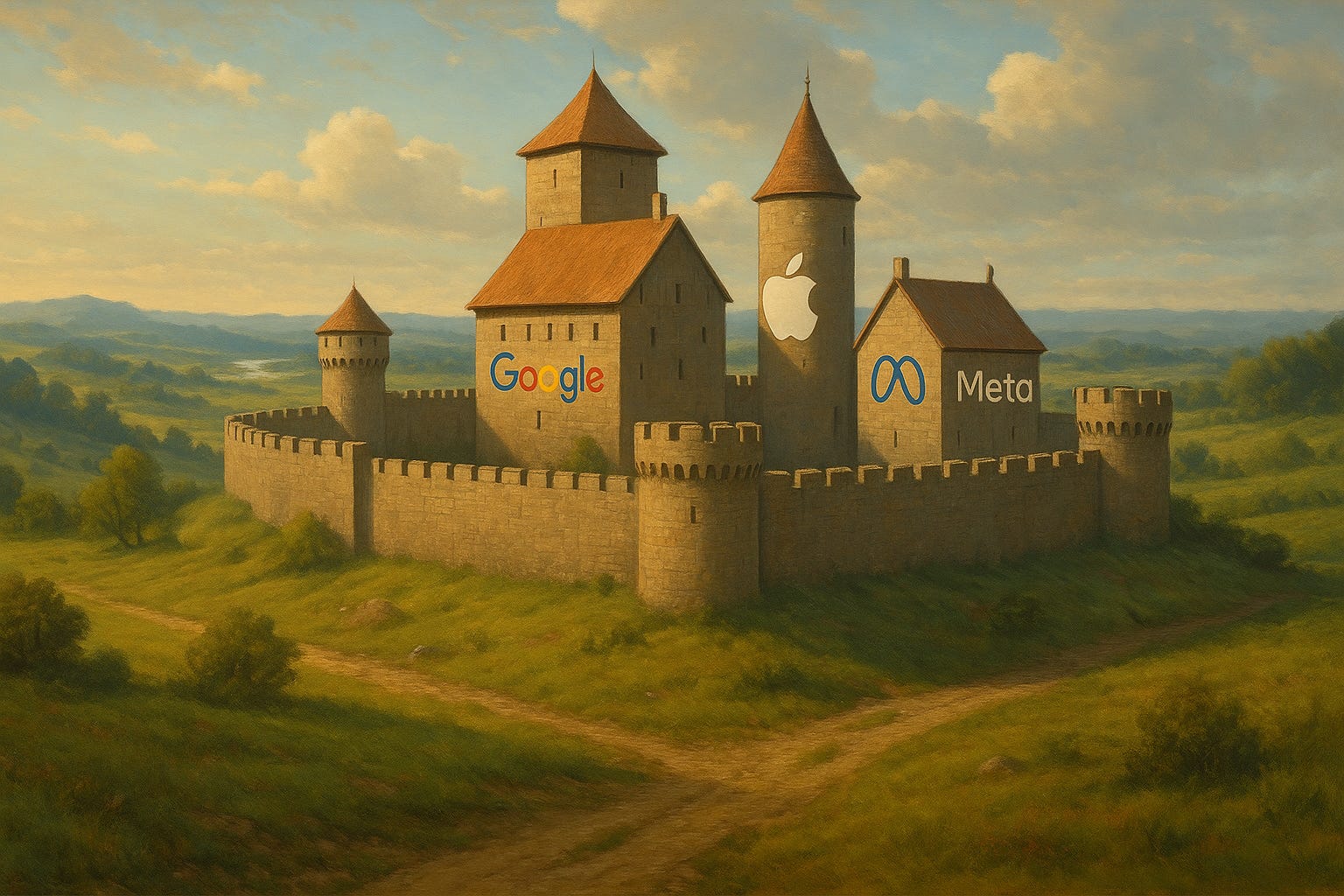
Before advancing this critique, I must make a caveat. Like many of my generation, I have also benefited from this technological revolution — professionally, intellectually, and personally. My own family’s story and financial success are intertwined with the rise of these platforms. And perhaps precisely because of that, we are critics coming from within, not from resentment but from responsibility. It is possible and necessary to hold gratitude and critique at once.
These technologies have undeniably brought extraordinary progress: access to knowledge, connectivity across continents, tools for creation and collaboration that would have seemed miraculous a few decades ago. But the question now is how to ensure that the new feudal lords of the digital age do not shape the world solely in their image, hoarding data, wealth, and influence while leaving workers, citizens, and even states with diminishing agency.
This tension between innovation and inequality, between benefit and dependence, is what defines our time. And it is in this tension that Technofeudalism, as described by Yanis Varoufakis, begins to take shape.
If we look back at the dynamics of capitalism in the previous century, we’ll notice that in nearly every country — and often within each region or city — there were local stories of success. Companies emerged, employed local people, and fostered local, regional, and national economies. Some nations managed to establish guardrails that curbed excessive concentration of power, building more balanced societies with broader inclusion and participation, and, as a result, more resilient democracies.
Even where those safeguards failed, there was still a recognizable industrial class and an entrepreneurial class — individuals who became affluent across virtually every sector, from manufacturing to media, from agriculture to retail.
Now, however, the landscape has changed. With the global reach of technology and the deep interconnectivity of our world, markets have collapsed into platforms. You no longer need dozens of regional music labels; you have Spotify. No local broadcasters; just Netflix, streaming everywhere. Retailers and artisans are displaced by Amazon, Mercado Livre, or Alibaba. Local transport companies give way to Uber. The infrastructure of capitalism, once decentralized, has been replaced by a handful of global platforms.
We are not replacing failed capitalists with successful ones; we are replacing successful capitalists with ultra-successful feudal lords.
Varoufakis points out that this concentration of power was accelerated by the complete deregulation of markets, which favored the biggest players. After the 2008 global financial crisis, the so-called quantitative easing policies injected more than $35 trillion into the global economy through the world’s central banks, supposedly to stimulate growth, support small businesses, and expand lending to individuals. In reality, much of that liquidity flowed upward. The largest corporations benefited disproportionately, strengthening their moats and data fortresses, often using surplus cash not to innovate, but to buy back their own shares. In many ways, a quiet signal that creativity had been replaced by financial engineering.
The ideal of the “free market,” so often invoked by the high priests of technology, has thus given way to a new regime of monopolies. And when a few giants dominate the economy, democracy is the first to erode.
As author and anti-monopoly advocate Matt Stoller warns, concentrated corporate power doesn’t just warp markets, it tilts the political playing field toward plutocracy. This is more than an economics lesson; it’s a warning. Political power today is not confined to ballots and policy; it lives in boardrooms, algorithms, and consolidated industries.
This is the silent migration toward Technofeudalism: a world where markets still exist in name, but sovereignty has shifted from citizens and workers to the lords of code and capital.
History offers comfort…and a warning.
Concentrated power is not new, and neither is resistance to it. As Stoller reminds us, at the dawn of the twentieth century, the United States was ruled by a handful of industrial trusts that controlled oil, steel, and railroads. But people fought back. Citizens organized, antitrust laws were enforced, unions were formed, and for a few decades, society rebalanced itself.
Since the late 1970s, however, we’ve witnessed a slow reversal. A quiet counter-revolution that has returned power to a few corporations and, in many cases, a few individuals.
Yet history’s earlier success should remind us that this trajectory is not inevitable. It can be reversed again. We need to understand it, organize, and act. I always remind pessimistic people that evolution never happens in a straight line anyway.
It should begin with awareness. This is why many, including myself, are writing about it, and we need help spreading the word.
Second, we need to break power apart.
No democracy can remain healthy when billions of people rely on a handful of private platforms to communicate, trade, and learn — each governed by a single executive wielding near-sovereign authority and influencing elections and policy making. Making huge companies smaller, as Stoller proposes, isn’t punishment; it’s preservation. When Google Search, YouTube, or Meta concentrates control over global discourse, democracy becomes brittle.
Third, we must reimagine the social contract of our time.
As Yanis Varoufakis argues, the problem is not technology itself, but its ownership structure. If users are the product, then freedom is an illusion. We can begin to change this by banning the extraction of personal data as the default business model. Let companies charge modest, transparent micro-fees for services — six cents per search, perhaps — rather than harvesting our private lives. Those unable to pay could receive public support, just as social programs guarantee access to water, energy, or education. Digital rights are civil rights. Alternatively, could there be models where people own their data and monetize it as they wish?
Then, we need to bring ethical behavior to the center of the discussion.
Paul Collier offers a blueprint rooted in pragmatic morality: coordinated taxation to prevent the hoarding of gains in tax havens; corporate boards that serve both commercial and public interests; and what he calls social maternalism: policies that help families build resilience through education, health, and dignified work. Countries like Germany made that decades ago with a dual-training system, where vocational schools and businesses collaborated to cultivate skilled workers, and we are seeing the same in China and other emerging economies.
Finally, as Geoffrey Hinton, one of the fathers of modern AI, reminds us, no individual action can offset systemic imbalance. Climate change wasn’t caused by households failing to recycle; it was driven by the unchecked lobbying power of fossil-fuel giants. Likewise, the future of AI, and of technology at large, depends on whether we can regulate concentrated power before it regulates us.
“We need highly regulated Capitalism” Hinton advises. He is right. But I believe we can go further. We can rethink our economic systems altogether, moving beyond the tired dichotomies that have framed the past two centuries. Between capitalism and communism, state and market, growth and fairness, efficiency and care, there lies a new moral frontier: one where technology serves people and the planet, not the other way around.
In the end, the question is not whether we should be techno-optimists or techno-critics. The question is who technology is for. If it is for the few, it will enslave us. If it is for the many, it can free us.
As Collier writes, “In a world where capitalism [or should we say, technofeudalism] increasingly favors the few at the cost of the many, societies must leave behind ideologies and create a policy rooted in pragmatism and moral standards.”
That may be the true manifesto of our time. Not one of blind optimism or dystopian fear, but of mature hope and techno-realism. A hope that sees technology not as theology, but as a tool. A hope that accepts complexity, embraces uncertainty, and insists that progress, to be worthy of its name, must be shared.
____
If The Interweave resonates with you, there are a few ways you can support this work: consider becoming a paid subscriber to help amplify its reach, share a Dispatch with someone who might value it, or simply mention it in your own circles. Every gesture helps, and I’m deeply grateful you’re here.
Another deeply thoughtful and well researched piece.
This is a sharp analysis. I’ve been writing about a closely related dynamic—the shift from traditional corporate power to what I call sovereign platform governance, where companies effectively become extra-democratic authorities. Your description of digital lords and algorithmic domains maps directly onto that transformation.
Sharing here in case it adds to the conversation:
https://substack.com/home/post/p-179316662