
Learning to Read the World
A quick note on writing, systems, and purposeful living

I wrote my last piece of 2025 as a love letter.
A pause felt necessary after that.
Not a retreat, but a moment to let words settle, life expand, and silence do some of its work.
So this is a return…not just to writing, but to why I am writing.
I’ve written my whole life, mostly sporadically, often privately. Notes in margins, reflections after conversations, fragments sparked by books, travels, contradictions. Writing has always been a way of thinking out loud, of organizing what felt otherwise too dispersed to hold.
The Interweave was born when that dispersion began to feel insufficient.
The world accelerated. Technology reshaped incentives faster than institutions could respond. Economics became omnipresent, yet rarely examined beyond headlines or ideology. Philosophy, once a shared tool for orienting life, was quietly outsourced to productivity frameworks and motivational slogans.
In this world, I felt the need to organize. Not answers, but lenses.
As I mentioned a few times (and also in the About section of this Substack), I grew up in a house shaped by intellectuals, by long conversations, by disagreement practiced as care. Dialectics were not academic exercises; they were a way of inhabiting the world. Later, I became an economist, an investor, and then, I found myself living in San Francisco — arguably the epicenter of the technological transformations that have defined the last two decades, and will likely define the next.
Those worlds rarely speak to one another: the world of intellectuality, business and technology, and philosophy.
The Interweave exists precisely in that tension:
between economics and ethics,
between technological possibility and human limitation,
between ambition and balance,
between progress and purpose.
I began publishing these reflections in July 2025. Quietly. Without a growth plan. Just consistency, curiosity, and care. Seeing them resonate with nearly four thousand readers has been both humbling and encouraging, not because of the number itself, but because it suggests a shared hunger for slower thinking in fast times.
As this year begins, I want to be explicit about what lies ahead.
What I’m proposing — to myself first, and then to you — is both challenging and rewarding.
I want to make economics useful again, not as an abstraction or ideology, but as a lens to interpret what is happening around us, and how it quietly shapes our own lives.
To understand incentives, power, trade-offs, and unintended consequences, not only in markets, but in politics, work, technology, and culture.
Economics, at its best, is not about numbers. It is about behavior. About choices made under constraints. About systems that reward some actions while discouraging others, often without our explicit consent.
I want to make philosophy feel practical again.
Not as doctrine, but as a daily discipline for living a more coherent, balanced life.
For Aristotle, devotion to thinking was not optional. Contemplation was the highest human activity precisely because it allowed us to examine our desires, refine our judgment, and orient our lives toward what he called the good. Philosophy, then, was not removed from everyday life — it was what prevented life from becoming reactive, excessive, or directionless.
In a world that rarely pauses, philosophy teaches us how to stop.
In a system that constantly pushes for more, it teaches us when enough is enough.
And in times of acceleration, it reminds us that clarity is a form of freedom.
And finally, I want to translate what is happening in the technological world. Not to celebrate it blindly, nor to fear it reflexively, but to understand how it is reshaping incentives, institutions, and even our sense of self. Technology promises progress, efficiency, and abundance. It also disrupts labor, concentrates power, accelerates inequality, and quietly rewrites social norms.
Holding these three lenses together is the core ambition of The Interweave: to make sense of a world where tools evolve faster than values, and where progress without reflection risks becoming disorientation.
Over the coming months, with philosophically-grounded arguments, and informed by the rapid technological changes we are seeing in the world, I’ll begin breaking down economic concepts, theories, and mental models into simple, digestible, and usable pieces — not to turn anyone into an economist, but to offer a toolbox for reading the world more clearly and choosing more deliberately within it.
Because the way we think about value shapes the way we allocate our time.
The way we understand incentives shapes the lives we build.
And the way we narrate progress ultimately defines what we believe a life is for.
As Keynes once warned:
“the ideas of economists and political philosophers, both when they are right and when they are wrong, are more powerful than is commonly understood. Indeed, the world is ruled by little else.”
If that is true — and I believe it is — then reclaiming those ideas is not an academic exercise. It is a personal responsibility.
Much of what passes today as “common sense” about work, success, growth, and even happiness is nothing more than old economic assumptions operating invisibly. We internalize them, we perform them, and eventually we confuse them with our own desires.
We optimize before we ask why.
We accelerate before we ask where.
We exhaust ourselves trying to win games we never consciously chose to play.
This is where economics, philosophy, and technology quietly converge.
Technology amplifies incentives.
Economics explains them.
Philosophy asks whether they are worth amplifying at all.
My intention with The Interweave is to hold those three in dialogue. Not to resolve the tensions between them, but to make them visible enough that we can relate to them more honestly.
Some essays will feel reflective, almost intimate.
Others will be more analytical, even didactic at times.
Many will likely oscillate between the two.
I won’t be offering blueprints for success, nor prescriptions for a “good life.” What I can offer is something more modest, and perhaps more durable: conceptual clarity. Words, distinctions, and mental models that help slow down thinking just enough for better questions to emerge.
If this works, economics stops being something that only explains markets and starts illuminating behavior.
Philosophy stops being something we admire and starts shaping choices.
And balance stops being a slogan and becomes a practiced constraint.
This is an experiment. One that asks for patience — from you as a reader, and from me as a writer.
But if there is a thread that connects everything I hope to explore this year, it is this:
a belief that understanding the systems we live within is inseparable from understanding ourselves.
And that a more intentional inner life is not a retreat from the world, but a prerequisite for engaging with it well.
So, after a brief silence, I return to writing in February.
Not with answers.
But with dialectic reflections.
With the same hope that I get every time I enter a library: the hope to attain knowledge and become wiser.
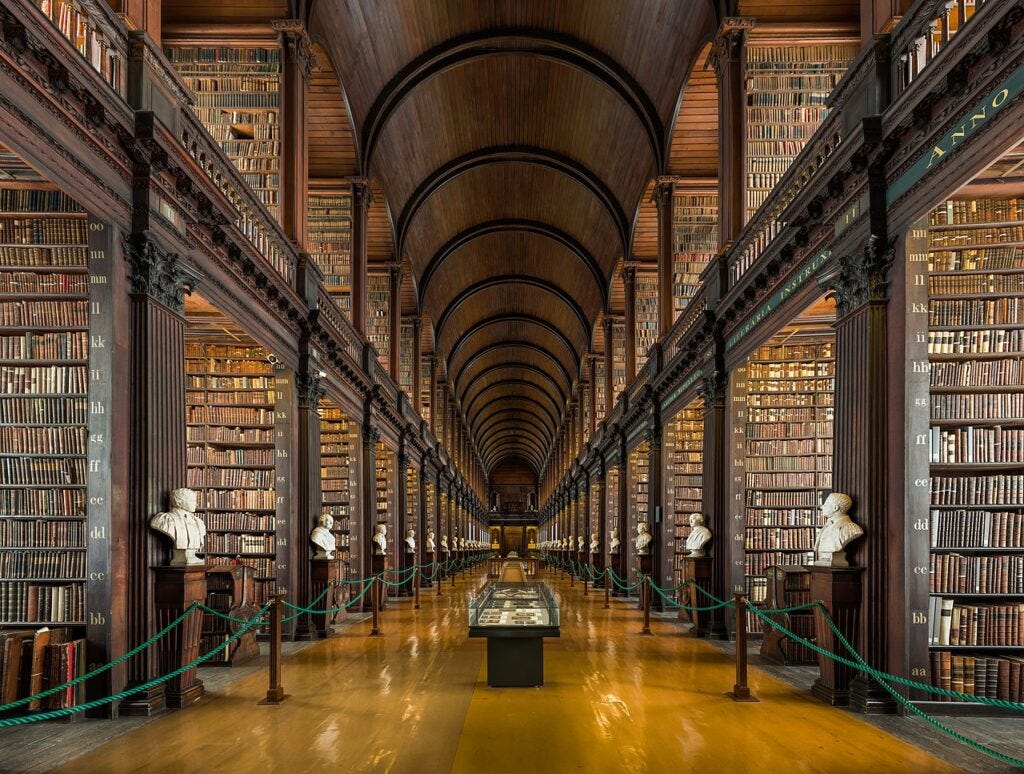
And with an invitation to think together a little more slowly, and a little more deeply, about the lives we are building inside this rapidly changing world.
Warm wishes for this New Year to you all!
Murilo
Love it! Keep them coming my friend and lets discuss the world over some good drinks and food when we see each other :) Cheers